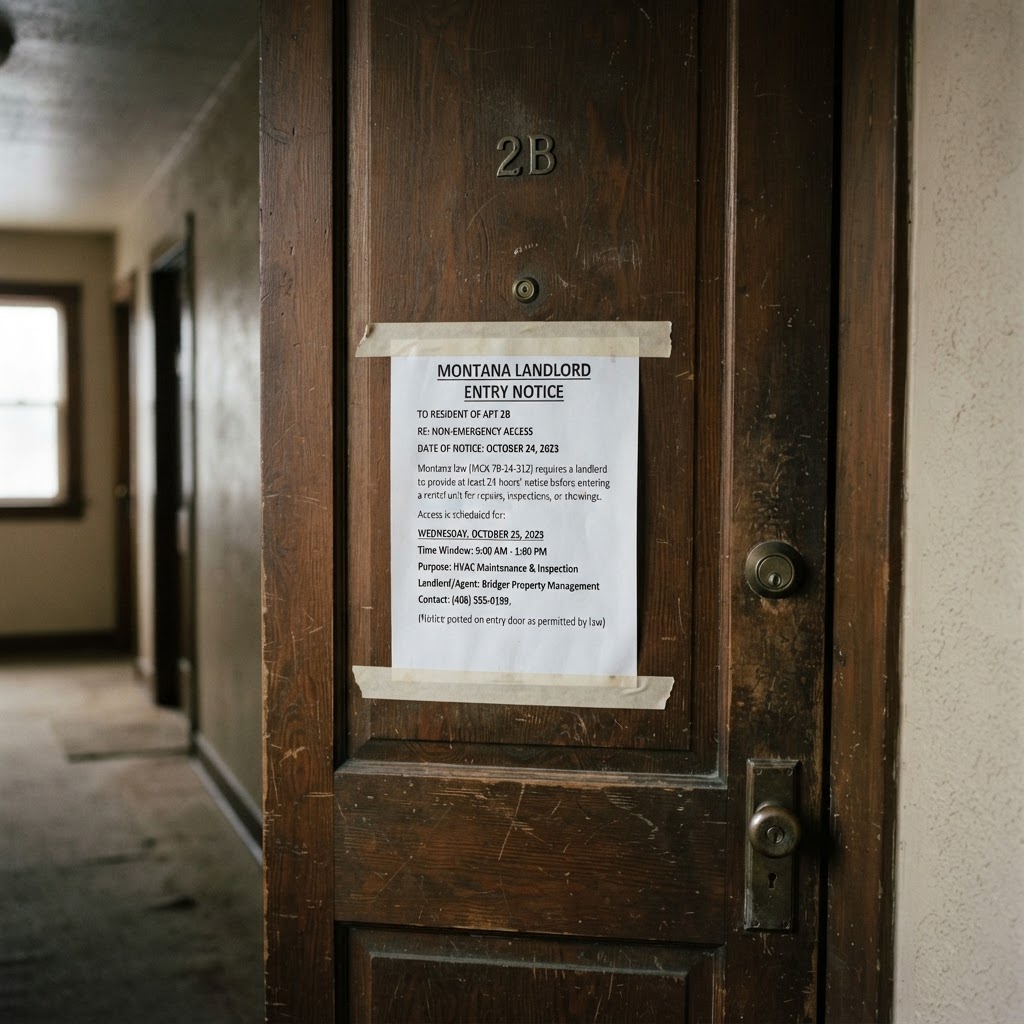
For property owners and investors across Montana, navigating the balance between property management and tenant privacy is a fundamental aspect of the rental business. Under the Montana Residential Landlord and Tenant Act of 1977, specifically Montana Code Annotated (MCA) 70-24-312, landlords are granted the right to access their rental units for specific, legitimate purposes. These include conducting inspections, performing necessary repairs or improvements, supplying agreed-upon services, and showing the property to prospective buyers, lenders, or future tenants, as noted by the Silverman Law Office ([4]).
Understanding Notice Requirements
To exercise this right of access, landlords must provide tenants with at least 24 hours' notice, except in specific circumstances. According to the Montana Legislature ([1]), this notice must be provided for all non-emergency entries. While the statute does not mandate that notice be written, legal experts at DoorKeeping ([5]) suggest that maintaining a dated, written record of the notice is a best practice to protect against future disputes. Furthermore, a 2021 amendment to the law clarified that landlords can satisfy this requirement by conspicuously posting their intent to enter on the unit’s main entry door ([6]).
It is important to note that "reasonable times" for entry are not strictly defined by the clock in Montana law, but they are generally interpreted as standard business hours ([2]). Landlords are explicitly prohibited from using their right of access to harass a tenant. As outlined by the Montana Law Help guide ([3]), repeated, unnecessary demands for access—even with 24 hours' notice—can be viewed as harassment, potentially allowing a tenant to seek court-ordered injunctive relief or terminate their lease agreement.
Emergency Exceptions and Tenant Obligations
Emergency situations, such as a fire, gas leak, or burst pipe, are the primary exceptions to the 24-hour notice rule. In these instances, a landlord may enter the premises without prior consent or notice to address the immediate threat to life or property ([2]). Beyond emergencies, court orders, or cases where a tenant has abandoned the property, a landlord has no other legal right to enter the unit without following the established notice procedures ([4]).
Conversely, tenants are legally obligated not to unreasonably withhold consent for entry when the landlord has a valid, statutory reason to access the unit ([8]). If a tenant refuses lawful access, the landlord may issue a 24-hour notice to correct the issue. If the tenant continues to deny access, the landlord may move to terminate the rental agreement with a 3-day notice, as described in the Montana Tenant-Landlord Guide ([3]). Additionally, tenants are prohibited from changing or adding locks without the landlord's written permission and must provide the landlord with a key if such changes are authorized ([1]).
For Montana investors, these rules underscore the importance of clear communication and meticulous record-keeping. Whether you are managing a single-family home in Kalispell or a multi-unit complex, maintaining a professional relationship with tenants and documenting every entry—including the date, time, and purpose—serves as a vital safeguard for your investment. By adhering to these statutory requirements, landlords can ensure they remain in compliance with state law while protecting the integrity of their property.